Menu Note


Use the menu below if you'd like to search for posts that relate to your interests. Note - this was just created on 12-30-20 so I will need to link the posts in the coming weeks. Until then, you can scroll down to the labels on the right to find the same information.


Showing posts with label 1972 ATG. Show all posts

Monday, February 3, 2020

Unopened Kellogg's Packs

I picked up a 1977 George Brett in its individual pack recently.  I am getting closer to finishing that set. 

Is anyone else working on these sets in packs?  My want list is on the blog for 1972 - 1974 and for 1977 - 1979.  I don't have enough unopened packs from 1970, 1971 and 1975 yet to make a list.

I should post a list for 1976 but I probably need more than half of the cards in that set.  That will be my goal for tomorrow. 

Does anyone ever seen these in bulk at card shows or card shops? 


I think I am also close to finishing the 1972 set in unopened packs.  I will post that as well. 

I am still waiting for someone to tell me if the Rold Gold cards came in sealed packs.  I have yet to see one.  Any ideas? 

Wednesday, January 1, 2020

The Most Damaged Kellogg's Card That I Own & My Odd Sorting Methods


I wish I had a good story about how this card got this way but I am not the original owner.  Bob Costas talked about carrying a 1958 All-Star Mickey Mantle in his wallet.  On some late-night talk show he pulled it out and it looked like this card.

This card reminds me of the Old Judge and other pre-WWII cards.  I wasn't sure I would be able to put it in a nine-pocket sheet because I thought it was going to break into pieces.  

I never flipped cards or put them in my bicycle spokes.  Mine got damaged for a few reasons.  First, I read them a lot and sorted them in different ways frequently.  Second, since we didn't have hobby supplies, we used photo albums with the sticky backing.  When leaving a card in there for a while we found out that the color leaking into the sticky backing.  That certainly took a toll on some of our best cards in the mid-70s.  

Now to sorting.  Kellogg's cards are easy to sort because the sets are small.  As I mentioned before, some of the card numbers are really small and my old, overworked screen use eyes can't always handle that depending on the lighting.  What did I do?  Revert back to my favorite sorting method from my childhood.

It helps being in an area with two major league teams.  I show my age by sorting the cards into the four divisions - AL East and West and NL East and West.  Then I pull up the checklist online and I can easily put them in order.  It keeps me from looking at the fine print at all.  


Sunday, April 21, 2019

1972 Kellogg's All-Time Greats Baseball Card Backs - #1

The countdown ends with card #1 - Walter Johnson.  He is labeled the Greatest Pitcher - Right-Handed.


He is believed to have the greatest fastball in the game.  He's mentioned as being tall and lean.  That might have been the case when he pitched, but baseball-reference.com lists him as 6-1 and 200 pounds which in total's game doesn't make him tall at all.  

He played 21 years with the Washington Senators - from 1907 to 1927.  

His career .217 ERA is more impressive since he pitched in the era with the highest batting averages.  His 1.14 ERA in 1913 earned him his first of two MVP Awards.  Winning 36 games that year helped too.   He was the first pitcher to be named MVP, then he was the second pitcher to be named MVP.  


The card mentions his impressive career totals with Senators teams that finished in the second division - the bottom half of the standings.  There is a reason that Washington was mentioned with this line - "first in war, first in peace and last in the American League".

They reached the World Series twice near the end of his career and they managed to win once.

The team was in Washington for 60 years.  The won three pennants but they averaged being 26.5 games behind in those years.  Here is a breakdown of those years.

Won AL - 3 times
Finished from 1 to 9 games of first place - 5 times
Finished from 10 to 19 games of first place - 9 times
Finished from 20 to 29 games of first place - 19 times
Finished from 30 to 39 games of first place - 14 times
Finished from 40 to 49 games of first place - 8 times
Finished from 50 to 59 games of first place - 2 times

That's 10 years being over 40 games out of first place and 46 years being at least 20 games out. 

Saturday, April 20, 2019

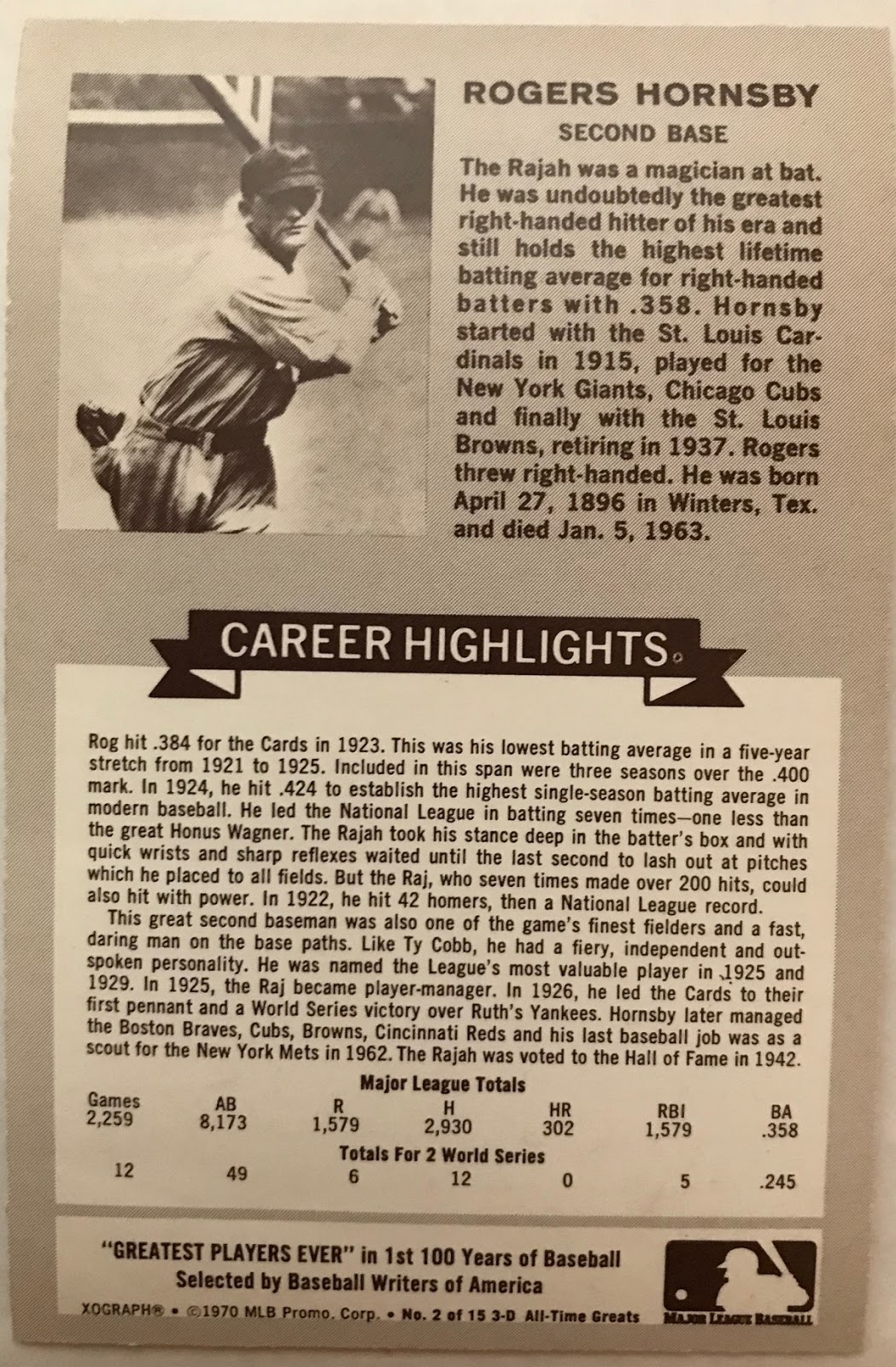
1972 Kellogg's All-Time Greats Baseball Card Backs - #2

I am going to finish learning about these players and reading the backs of their cards.  Once again, the back is from the 1970 Rold Gold set.

This card features the Greatest Second Baseman as determined by the Baseball Writers of America after the first 100 years of baseball - Rogers Hornsby.


I first learned about Hornsby's hitting by playing a baseball board game that a neighbor had.  Was there a Strat-O-Matic version that had sheets for the all-time best players from each team?  


As of 1969 Hornsby held the highest lifetime average (.358) for a righty.   That won't change anytime soon.  He's also second all-time to Ty Cobb, something I learned from Topps in 1973.

The card says he played for four teams, which seems like a lots for star player in that era.  He actually played for five - they missed the Boston Braves.

He had the highest single-season average - .424.  He led the league in batting seven times.   Like others from this era, averages are higher since the league averages were the highest ever seen in baseball.  (Cochrane's Card From This Set).  I knew all of that but I didn't know that he held the NL HR record when he hit 42 in 1922.  

His last baseball job was as a scout for the Mets.  Not something to brag about since that was a horrible expansion team, but he made his debut in 1915 and he was still in baseball in 1962.  He did in January of 1963, so I assume he didn't even retire.  

Friday, April 19, 2019

1972 Kellogg's All-Time Greats Baseball Card Backs - #3

Same as yesterday - I am showing a 1970 Rold Gold.

John McGraw was given the honor of being named the Greatest Manager.  Even though I've been a coach for a long time, I've never spent much time reading about managers.  I will probably learn a few things about him.

He played for 17 years but that is misleading.  In his last five years, 1903 to 1907,  he batted a total of 25 times.  He began managing the Giants in 1902 so that probably had a lot to do with him not playing much at the end of his career.  He was only 34 when he played in his last game.

He had two nicknames - Mugsy or Little Napoleon.   He managed until 1932, 


He had a "riotous, successful 30-year career with the New York Giants" says the card back.  He is also mentioned as being an innovator.  The card credits him with the hit-and-run and specific situational bunting. 

This is stuff that won't be put on a PC card today.  It is mentioned that McGraw insulted rival owners and managers and also used his fists on the field?  Now we freak out over a bat flip following a home run.

He's also considered the first manager to hire someone for pinch-hitting only as well as someone for relief pitching only.


He is still second all-times in managerial wins, trailing Connie Mack by almost 1,000.  Mack coached 53 years and even with a losing record over his career, that record is probably safe until a computer ends up managing a team.  McGraw had a .586 winning percentage.  


Thursday, April 18, 2019

1972 Kellogg's All-Time Greats Baseball Card Backs - #4

Sorry, I got a bit lazy with the photos.  This one and the next three are pictures from the 1970 Rold Gold Set, but that is close enough.

The Greatest Catcher was declared to be Mickey Cochrane.  I needed to learn more about him since his name doesn't come up as one of the biggest stars in baseball history.


Wikipedia said he was called Black Mike because of his "fiery, competitive nature".    He had a .320 career average, which was the highest for a catcher until 2009 - again according to Wikipedia.  Joe Mauer was the new leader at that time.  Mauer's average subsequently dropped to .306 so Cochrane is back on top.

It certainly helped that Cochrane played in an era when batting averages were higher than in today's game.  Of the top 10 AL season averages, five occurred during his career and the other five were from 1920 - 1924.


His is credited with inspiring his team and working well with the pitching staff.

His career ended after he was hit in the head by a pitch by Bump Hadley in 1937.  He was still just 34 years old.

He was a two-time AL MVP although the MVP voting rules were different back then.


Sunday, March 31, 2019

1972 Kellogg's All-Time Greats Baseball Card Backs - #5

It's taking a while to get through this 15-card set even though it is one of my favorites.  I've been busier than ever since my summer job has begun.  I only spent four hours on it this week, but teaching and coaching are quite time consuming now.

George Sisler is card number 05 in the 1972 Kellogg's All-Time Greats set as well as the 1970 Rold Gold set. 

Sisler was a first baseman finalist.  Not easy to get past Lou Gehrig on this team.

Ballplayers called him the perfect player because he hit for average and power and he could steal bases.  Twice he was able to hit over .400. 

Let's see what baseball-reference.com says to back that up.  A .340 career average is a good start.  75 steals and 102 homers when the home run wasn't as common as it is today.  That average is good for 16th all-time.

The second paragraph on the back of the card.  I never knew that he sat out an entire season since a sinus problem affected his vision.  It is mentioned that he was on a pace to break Ty Cobb's records until he was derailed a bit by this problem.  It also cost him 3,000 hits since he ended up with 2,812.

Before his missed season his career average was .361.  Cobb is the only one with a higher career average.  Cobb is now listed as hitting .366 but I remember from his 1973 Topps card that his career average was .367.  It even shows it on the front of the card.

He graduated from the University of Michigan.  His 257 hits in a season (154 games) was the record from 1920 until 2004 when Ichiro Suzuki had 262 hits in 2004.   Ichiro played in 161 games on his way to the batting title with a .372 average, the highest of his career.

Two of his sons (Dave, Dick) played in the majors.  Dave had a 38-44 career record over seven years.  Dick had 55 homers over eight seasons.  Their careers didn't overlap since Dave is 11 years younger than his brother. 

Saturday, March 23, 2019

1972 Kellogg's All-Time Greats Baseball Card Backs #6 and #14 - Babe Ruth

A 15-card set with two Babe Ruth cards.  I haven't heard anyone complain about that either.  Time to take a look at the backs of the cards. 


I pictured the first card from the 1970 Rold Gold set and the second one from the 1972 Kellogg's All-Time Greats set.  There isn't any difference other than the copyright line on the bottom.

Ruth is the all-time home run king and basically amazing in all facets of the game.  He's mentioned as the Sultan on Swat.

The bio begins by talking about how he came into the league as a star pitcher.  One of his records was hitting 60 homers in a 154-game season.  This bitterness towards Roger Maris still lingered I guess. 

I divide my friends into two age groups.  The old guys who were born when Babe Ruth held the single-season HR record and the rest of us born when Maris was the single-season leader. 


Both cards mention his pitching feats and sale from the Red Sox to the Yankees.  It is also noted that he drew the fans to the ballpark.

His Word Series pitching performances are mentioned on both cards as well.


Friday, February 22, 2019

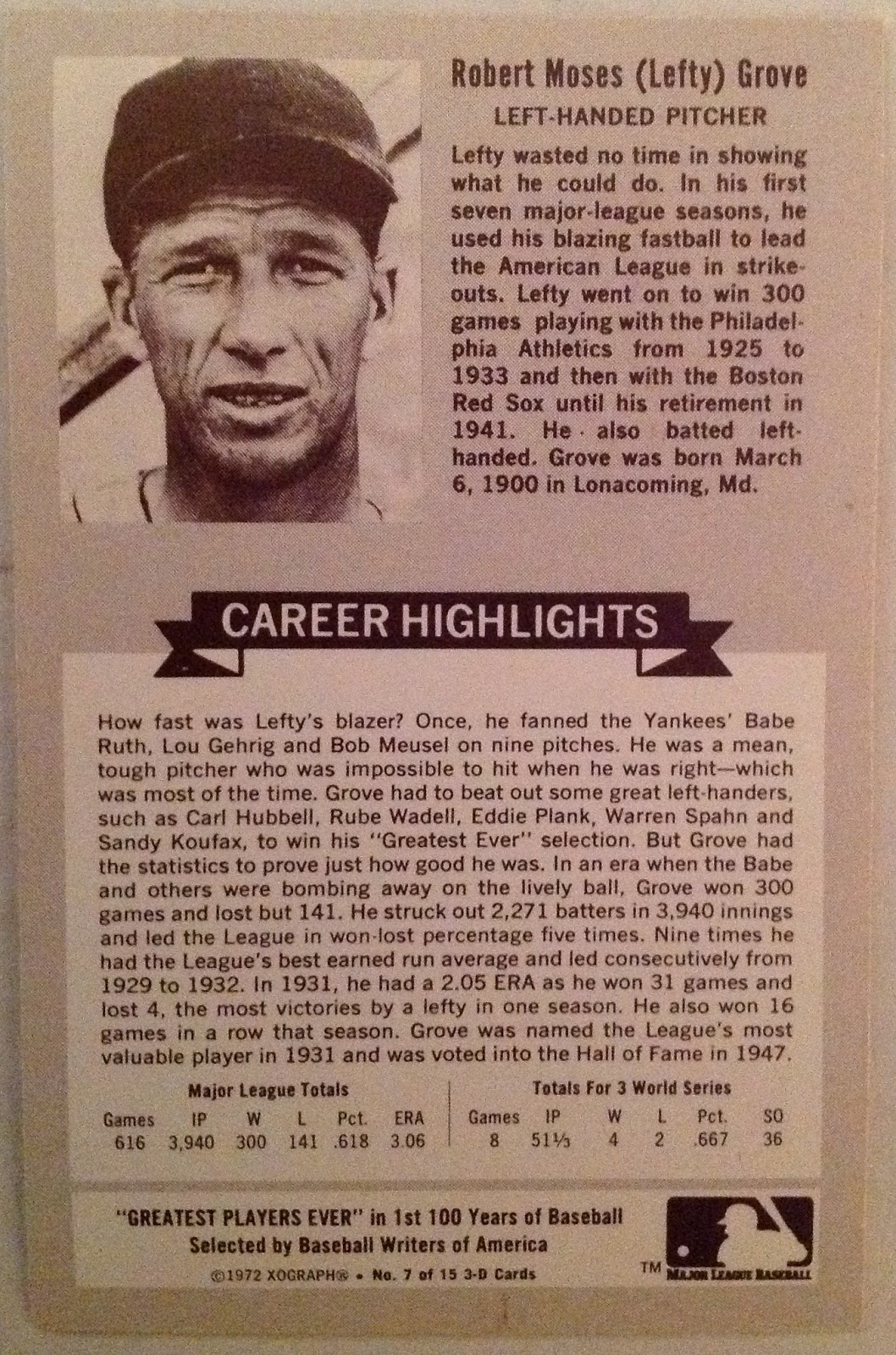
1972 Kellogg's All-Time Greats Baseball Card Backs - #7

 I can confess to knowing very little about Lefty Grove.   I've always paid more attention to the National League and he played his entire career in the AL.


What can Kellogg's teach me about Grove?  I knew he was a left-handed pitcher with 300 wins already.  Wow, he led the AL in strikeouts during his first seven seasons.  

I checked that on baseball-reference.com.  He never again led the league in strikeouts in his 17-year career.  The site showed that he led the league in ERA nine times.  

Roger Clemens is second to Grove in number of seasons leading the league in ERA.  Clemens accomplished this seven times.  

Only three players have led the league in strikeouts more than seven times - Walter Johnson, Nolan Ryan and Randy Johnson.  None of them led the league in their first two seasons.


Nice to see that he fanned three famous Yankees (Ruth, Gehrig, Meusel) on nine pitches. 

This is the first mention in this set of someone being named Greatest Ever for this card set.  He beat out Hubbell, Wadell, Plank, Spahn and Koufax for the honor.

He had 31 wins in a season, the most ever by a lefty.  He won 16 games in a row during that season. 

Monday, February 18, 2019

1972 Kellogg's All-Time Greats Baseball Card Backs - #8

Time to check out the back of Pie Traynor's 1972 Kellogg's All-Time Greats card.


He was a defensive star as well as a .320 lifetime hitter.  


He was known for covering a lot of ground, more than any player at his position ever says Kellogg's. 

He stayed in baseball as a manager, then as a scout.  He spent lots of time working with the kids in Pittsburgh.

This set declared him as the Greatest Third Baseman, but Bill James and others would argue that. 


I have no idea about the picture on the back of the card above.

Saturday, February 16, 2019

1972 Kellogg's All-Time Greats Baseball Card Backs - #9

No sunshine at home so I am back to talking about the 1972 Kellogg's All-Time Greats baseball card backs.  Today I am down to #9 - Honus Wagner.


"The Flying Dutchman" had a .329 career average and was know as an amazing fielder.  He hit over .300 17 times in 21 years.


Kellogg's called him a " bow-legged, thick-framed man".  At some point in his career he played every position except catcher.  He won eight batting titles.  

The card mentioned that Stan Musial recently bettered lots of Wagner's records.  Recently was at least seven years before the 1970 cards were produced and two more years until the Kellogg's set was issued.  

He is mentioned as a "gentle giant" and to make sure we know that he was "bow-legged" it is mentioned a second time in the paragraph.

Tuesday, February 5, 2019

1972 Kellogg's All-Time Greats Baseball Card Backs - #10

Back for another look at a great set - the 1972 Kellogg's All-Time Great set.  Today I am down to card #10 - Eddie Collins. 

I'm working late on this since school was already canceled for tomorrow due to ice storms.  That just means more time to train and organize my cards, both tasks that I never have enough time to do.

My knowledge of Collins is somewhat limited, so just like other cards in this set, I am learning some new things.  I mainly have collected cards from the post-WWII era since they were affordable when I was a kid in the 1970s.


I knew that Collins was on the White Sox / Black Sox in 1919.  He played 12 years with the Sox, but he actually played 13 more with the A's.  

I knew that he had lots of steals, but I didn't realize he hit .333 and had an MLB-record 512 sacrifice hits.  Of course averages were higher during that era.  

On to the back of the card with a nice picture of the White Sox uniform.  He led his position in fielding nine times.  


He's credited on this cards with 509 sacrifices, a number that is now 512 on baseball-reference.com. 

He was elected to the Hall of Fame in 1939.

He played in six World Series from 1910 to 1919, and he was on the winning team four times, the losing team once and the Black Sox team that lost in 1919. 

Saturday, February 2, 2019

1972 Kellogg's All-Time Greats Baseball Card Backs - #11

Speaker was the Center Fielder Finalist when the team was selected. 


He played from 1906 to 1928 for four different teams.  He was a Texas cowhand, whatever that is.  FYI - that is someone who tends to cattle.  

Look closely at the picture on the back.  Check out where his hands are on the bat.  That is definitely an old school approach.  

The card mentioned that he had one liability - he was overshadowed by playing during the same time as Ty Cobb.  He had a .3447 career batting average while Cobb leads the MLB rankings at .367.  Shouldn't that officially be .345?  Baseball-reference.com has him at .345 and Cobb at .366.  


Due to Cobb winning 12 batting titles, Speaker only managed to win one.

He still has the all-time lead in career doubles, and he led the league in that category eight times.

It was mentioned that he might not have been the greatest fielder, but he did become the first centerfielder to play shallow. 

Both Speaker and Cobb finished their careers in 1928 with Philadelphia's A's.  Too bad they didn't play their last game on the same day. 

Monday, January 28, 2019

1972 Kellogg's All-Time Greats Baseball Card Backs - #12 Cy Young

Snow has been another one of the things keeping me from organizing my cards and adding to this blog.  Today the snow is allowing me time since my school was canceled for today.

I'm skipping Babe Ruth for now, #13 in the set, since I forgot to get the picture.  On to Cy Young.


Even though the focus of these cards is the back, the front is certainly interesting.  Young was only a "finalist" and not the "Greatest Right Handed Pitcher".  That honor went to Walter Johnson who is honored with card number one in this set.  

Why isn't the pitching award the Walter Johnson Award?  More about that when I discuss Johnson's card.


Wow, he won 20+ games in 16 different seasons.  Well, he did start an average of 50 games per season during his first eight seasons.  He often pitched both games of a doubleheader.

He pitched baseball's first modern-day perfect game.  He added two more no-hitters.

He was quite durable as evidenced by his leading the all-time lists in wins, lossess, games started, complete games (749!) and innings pitched.  The last time that all of MLB exceeded 749 complete games was 1980.

Mariano Rivera got 100% of the votes this year.  When Young was elected, he received only 153 of 201 votes.  Things were certainly different at the start of the Baseball Hall of Fame.

Wednesday, December 26, 2018

1972 Kellogg's All-Time Greats Baseball Card Backs - #14 Lou Gehrig


I mentioned previously that I wasn't able to chase these cards as a kid since we didn't buy the products, but there is more.  We started going to card shows in 1975.  These events were nothing like today's events.  In 1975 there might have been people selling newer cards, but I don't remember much about that.

What I remember is seeing stacks and stacks of old baseball cards everywhere.  Some people had albums and pages of some kind, but most of the cards were just in stacks on the dealer tables.  My normal $20 - 35 would certainly all be spent, but I don't think I ever bought a card newer than 1969.

Once a dealer was treating us like we didn't know our stuff so we asked him about a 1933 Goudey Lou Gehrig.  I wasn't going to spend all of my money on one card but when he told us $50 we debated for a while whether we should pool our money and buy it.  No, I was (and still am) too cheap to do that.  I rarely spent more than $2 on any card.  Instead I bought a bunch of cheap cards that probably had soft corners.

Back to the Lou Gehrig card, one of my favorites.


#14 - Lou Gehrig


Great photos on the front and back.  He died from a paralyzing disease which caused him to retire after the 1939 season.  His 2,130 games streak is mentioned too.

The career highlights start by mentioning Wally Pipp and his headache.   Gehrig played every day until asking manager Joe McCarthy to take him out in early May of 1939.  He stayed with the team all season, but he never played again. 

After his retirement he was immediately named to the Hall of Fame in a Special Election.  No vote counts are shown on baseball-reference.com.  Only one other player has been named to the Hall of Fame via a Special Election - Roberto Clemente. 

The card mentions Lou Gehrig day and Babe's 60-homer season when Gehrig took home the MVP Award.

One last Gehrig story.  About 30 years ago I had my hands on a Ruth/Gehrig ball and a ball from the entire Yankees team from one of those years.  How?  A friend's grandmother was a classmate and friend of Gehrig's from Columbia University.  It was cool to hold them knowing that they were authentic.  Those baseballs weren't going to leave that family, which is awesome.  I wonder if they still have them?  If they lived in my area I would certainly find out. 

Tuesday, December 25, 2018

Time for Kellogg's All-Time Great Card Backs - #15 Ty Cobb

I've always liked these card backs and these cards.  It doesn't bother me that they are the same cards as the 1970 Rold Gold cards except for the date stamp on the bottom.

I like that there is a picture, a bio, career highlights and career stats including World Series stats.  I don't like that there are not year-by-year stats and some demographic information about the players who all played long before my time.


#15 - Ty Cobb

Cobb was called the most feared player in the game.  A .367 career average, highest in history, will do that.  Add stolen bases, RBIs and even homers and that makes him dominant.

He used a split-hand grip.  I wonder if kids read about that in the early 1970s and then tried it out.
He led the league in hitting for 12 of 13 years at one point in his career.  In the "off" year he hit .371.  Baseball-reference.com now credits him with hitting .370 in 1916.  Tris Speaker hit .386 to stop Cobb's streak.  Cobb won 12 batting titles and he led the league in numerous other categories.

Cobb hit .401 later in his career without winning a batting title.  George Sisler hit .420 in 1922 to deny Cobb another title.

He managed the Tigers for six years without taking them to the World Series.  His last post-season game was in 1909 and he retired in 1928.

Not on the card but included on the regular 1972 cards -

Position - Outfield
Height - 6-1
Weight - 175
Hobby - being disliked?

Not on the card - when the first Hall of Fame class was voted in, Cobb had more votes than the other five elected - Babe Ruth, Honus Wagner, Christy Mathewson and Walter Johnson.

Monday, December 24, 2018

Was Topps Paying Attention to Rold Gold Cards?


 The 1970 Rold Gold card set had great card backs, even including a photo of the player.  The 1972 Kellogg's All-Time Greats card shown below is identical other than the date at the bottom.


The card provides lots of career highlights and summary information since they skipped yearly statistics.  I always liked the statistics, but it was nice to read something about these players who I never watched play the game.  

In 1971 Topps added a picture to the back of their baseball cards for the first time.  Did they get this idea from the Rold Gold cards?  Whey did Topps abandon the idea again until 1993?


Kellogg's then added photos to the back of their cards in 1971. 

Friday, August 10, 2018

I Did Better on ebay Than at the National?

Here is what I had waiting for me at home this week.


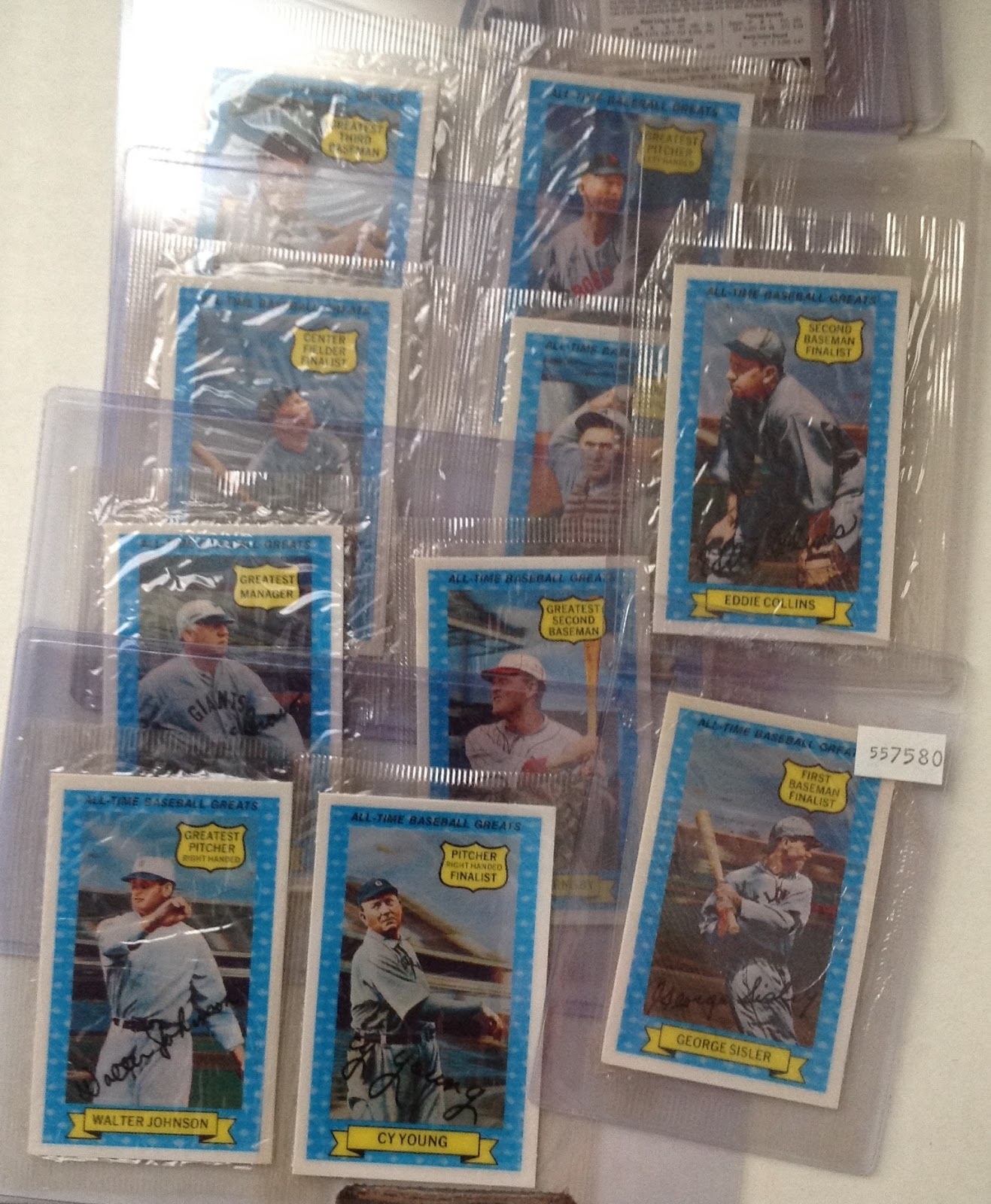
Yes, those are all in the original wrappers.  Ruth, Gehrig and a few others are not cracked.  The others are cracked and one has a bad wrapper rip, but this is a nice lot.

No one has let me know if the Rold Gold and Kellogg's cards that are found in packs display any differences.  I have yet to see any unopened packs with the 1972 date. 


Tuesday, June 5, 2018

Another Proof Card That Varies From the Actual Card Produced

I already found that I had a few proof cards that weren't exactly the same as the card produced by Kellogg's.  Today I noticed that one of my favorite cards, Lou Gehrig's All-Time Greats card, varies slightly from the product issued. 

The proof card listed is dated 1972, but it is most likely a 1970 Rold Gold proof card.  Why do I think that?  The first card shown below could be either a 1970 Rold Gold or 1972 Kellogg's.  Notice where the signature is located on the card.   The signature is in the same place on both cards. 


The proof card has the signature in a different place.  The signature doesn't look that good on the proof card so they lowered it to make is more visible. 


I am still looking to find more proof cards from the Benanti Collection.  If you know how I can do that please let me know.

Tuesday, May 22, 2018

Sometimes a Fuzzy Picture is Okay

I picked up a small lot of cards last week on ebay.  The pictures weren't good so I didn't bid very much.  I just couldn't resist because they were 1972 ATG cards.  I was the same way with Kenner Starting Lineup Figures.  I always wanted to get the 1989 Baseball Greats.


Other than the curling, I was happy with the cards.  Would I buy a set with a blurry picture?  Sure, if the price were right.